
Showing posts with label Space. Show all posts
Showing posts with label Space. Show all posts
Sunday, March 3, 2013
The Higgs Particle And The Apparent Instability of Our Universe
 |
| Image credit: Cern -simulated data modeled for the CMS particle detector |
According to Dr Lykken, via BBC News:
"It turns out there's a calculation you can do in our Standard Model of particle physics, once you know the mass of the Higgs boson," - "If you use all the physics we know now, and you do this straightforward calculation - it's bad news." - "What happens is you get just a quantum fluctuation that makes a tiny bubble of the vacuum the Universe really wants to be in. And because it's a lower-energy state, this bubble will then expand, basically at the speed of light, and sweep everything before it,"
As best as I understand all of this. One of the debated physical properties of the universe in which we all live, is that the vacuum in which said universe exists, is not as stable as it could be. The notion that this instability is one of the physical properties of our current universe, isn't a new one. But determining weather or not this theory is true, is all based on a calculation involving the frequency of the higgs' own mass, versus that of the top quark's pole mass, amongst other things. If our current understandings of those measurements and calculations hold true, then it's possible that at some point in the distant future - as in, an incomprehensibly long time from now- a fluctuation within the field which maintains said vacuum, could cause it to re-align itself into a more stable state. Meaning; The universe in which we currently live, will be no more. Which sounds bad. But, again, you're gonna be dead anyway. So don't worry too much about that. Besides which, the calculations described by DR. Lykken also bring with them another possibility: What if the end, is really just the beginning?
"It's much easier to explain a lot of things if what we see is a cycle. If I were to bet my own money on it, I'd bet the cyclic idea is right," - Dr.Joseph Lykken [BBC]
 | ||
| Potential evidence of successive big bangs/Gurzadyan and R. Penrose |
Source: BBC News
Image Credit: Cern , Gurzadyan and R. Penrose


Thursday, February 28, 2013
APOTD: Ghost Nebula

Caption: NOAO
This image was obtained with the wide-field view of the Mosaic Camera on the Mayall 4-meter telescope at Kitt Peak National Observatory. vdB 141 is a reflection nebula located in the constellation Cepheus. Sometimes referred to as the ghost nebula, its awkward name is its catalog number in Sidney van den Bergh's catalog of reflection nebulae, published in 1966. Several stars are embedded in the nebula. Their light gives it a ghoulish brown color. North is down and East is to the right. Imaged August 28, 2009.
Image: T.A. Rector/University of Alaska Anchorage, H. Schweiker/WIYN and NOAO/AURA/NSF [high-resolution] Read NOAO Conditions of Use before downloading
Sunday, February 17, 2013
Russian Meteor videos
As you are likely well aware -because unlike me, you exist in the same time frame as most other people in the world- a large meteor went streaking across the sky in Russia early Friday morning (FEB 15th). The object is not believed to have been directly related to the much more massive -150 feet (45 meters) wide- asteroid 2012 AD14, which passed within about 17,000 miles of Earth later the same day, without incident.
NASA has estimated the size of the object over Russia, at 50-55 feet across, and 7,000 -10,000 tons, and that it was traveling somewhere in the range of 40,000 MPH, when it exploded. The blast created as the meteor impacted with the Earth's atmosphere is estimated to have been the equivalent of a 470-kiloton explosion, and managed to cause sever damage to a Zinc processing plant, as well as shattering windows throughout the city of Chelyabinsk, injuring about 1000 people. The incident is being described as the most significant of it's kind since the Tunguska event of 1908, in which an unknown object - possibly a small comet - exploded over the Russian wilderness, leveling trees for several hundred square miles.
There are obviously LOADS of videos and pictures available of the incident. Of the two I've chosen to post, the one above is sort of a compilation, which includes bits from many of the most popular videos, along with some stuff I hadn't seen from security cameras, as well as footage of some of the damage caused by the blast. The one below, I choose because it captures the gap between the object's passing, and the sound of the explosion itself. Which, as you'll see, happens a considerably long time after the object has disappeared from view, illustrating just how fast it was actually traveling.
Posted by YouTube user: Idan Drori
-CAINE-
Source: All of the Internets
Tuesday, January 29, 2013
APOTD: Molecular Cloud in Monoceros
 |
| Image: T.A. Rector (University of Alaska Anchorage) and N.S. van der Bliek (NOAO/AURA/NSF) [high-resolution] Read NOAO Conditions of Use before downloading |
Caption: NOAO
This image was obtained with the wide-field view of the Mosaic II camera on the Blanco 4-meter telescope at Cerro Tololo Interamerican Observatory on January 11th, 2012. It shows a portion of the giant Monceros R2 molecular cloud. It is a location of massive star formation, particularly in the location of the bright red nebula just below the center of the image. The image was generated with observations in the Sulphur [SII] (blue) and Hydrogen-Alpha (red) filters. In this image, north is to the right, and east is up.
Wednesday, January 23, 2013
APOTD: Soap Bubble Nebula
 |
| Image: T. A. Rector/University of Alaska Anchorage, H. Schweiker/WIYN and NOAO/AURA/NSF [high-resolution] |
Caption: NOAO
nformally known as the "Soap Bubble Nebula", this planetary nebula (officially known as PN G75.5+1.7) was discovered by amateur astronomer Dave Jurasevich on July 6th, 2008. It was noted and reported by Keith Quattrocchi and Mel Helm on July 17th, 2008. This image was obtained with the Kitt Peak Mayall 4-meter telescope on June 19th, 2009 in the H-alpha (orange) and [OIII] (blue) narrowband filters. In this image, north is to the left and east is down.
PN G75.5+1.7 is located in the constellation of Cygnus, not far from the Crescent Nebula (NGC 6888). It is embedded in a diffuse nebula which, in conjunction with its faintness, is the reason it was not discovered until recently. The spherical symmetry of the shell is remarkable, making it very similar to Abell 39.
:
Monday, January 21, 2013
APOTD: Saturn's Glowing Aurora
 |
| Image: NASA/JPL/University of Arizona/University of Leicester[high-resolution] |
Caption: Cassini Solstice team
This false-color composite image, constructed from data obtained by NASA's Cassini spacecraft, shows the glow of auroras streaking out about 1,000 km (600 miles) from the cloud tops of Saturn's south polar region. It is among the first images released from a study that identifies images showing auroral emissions out of the entire catalogue of images taken by Cassini's visual and infrared mapping spectrometer.
In this image constructed from data collected in the near-infrared wavelengths of light, the auroral emission is shown in green. The data represents emissions from hydrogen ions in of light between 3 and 4 microns in wavelength. In general, scientists designated blue to indicate sunlight reflected at a wavelength of 2 microns, green to indicate sunlight reflected at 3 microns and red to indicate thermal emission at 5 microns. Saturn's rings reflect sunlight at 2 microns, but not at 3 and 5 microns, so they appear deep blue. Saturn's high altitude haze reflects sunlight at both 2 and 3 microns, but not at 5 microns, and so it appears green to blue-green. The heat emission from the interior of Saturn is only seen at 5 microns wavelength in the spectrometer data, and thus appears red. The dark spots and banded features in the image are clouds and small storms that outline the deeper weather systems and circulation patterns of the planet. They are illuminated from underneath by Saturn's thermal emission, and thus appear in silhouette.
The composite image was made from 65 individual observations by Cassini's visual and infrared mapping spectrometer on 1 November 2008. The observations were each six minutes long.
What would traveling through Hyper-space REALLy Look Like?
 |
| THEY'VE GONE PLAID! |
Via: Gizmag.com:
 |
| Traveling Through Hyperspace. Image: University of Leicester |
As the spaceship makes the jump to hyperspace, the wavelength of the light from the stars would shift out of the visible spectrum into the X-ray range. Meanwhile, Cosmic Background Radiation (CBR), which is thermal radiation that is spread fairly uniformly across the universe and is thought to be left over from the Big Bang, would shift into the visible spectrum, appearing to the crew as a central disc of bright light.
“If the Millennium Falcon existed and really could travel that fast, sunglasses would certainly be advisable,” said Connors. “On top of this, the ship would need something to protect the crew from harmful X-ray radiation.” "
So basically, what you'd see -assuming you could look out a window in the first place, which seems inadvisable given the torrents of amplified thermal radiation pounding against your vessel, but if you could. Odds are you'd see something like the representation above. By which I mean the still black and white one not the gif, that's from Spaceballs; there's probably not a lot of plaid in hyper space
But even if the truth about traveling at light speed isn't as interesting as you might like it to be, aesthetically speaking. It's still a pretty awesome thing to try and imagine; stars streaming at you so quickly that they all soon disappear from view behind a wall of white hot light. Not to mention the astounding distances you'd be traveling while they do it. And more importantly. Knowing, not only what traveling through hyper space might look like, but also what it would mean for the levels of deadly microwave radiation bombarding any ship traveling through it, are just two more examples to add to the already lengthy list of reasons for us all to stop and acknowledge Star Trek's superiority to Star Wars. Since it's now obvious that Luke, Han, and the gang, would clearly have been cooked like potatoes through those 70's party-van style portholes on the Millenium Falcon. While Kirk, Picard and the rest, would have been just fine observing the universe on an advanced view-screen from the comfort and safety of their shielded Starship.
And isn't that what REALLY matters?
I think it is.
Posted by YouTube user: WilliamShatner
-CAINE-
Source: Gizmag.com
Monday, January 14, 2013
APOTD: Tectonics on Enceladus

On Oct. 5, 2008, just after coming within 25 kilometers (15.6 miles)
of the surface of Enceladus, NASA's Cassini captured this stunning
mosaic as the spacecraft sped away from this geologically active moon of
Saturn.
Craters and cratered terrains are rare in this view of the southern
region of the moon's Saturn-facing hemisphere. Instead, the surface is
replete with fractures, folds, and ridges—all hallmarks of remarkable
tectonic activity for a relatively small world. In this enhanced-color
view, regions that appear blue-green are thought to be coated with
larger grains than those that appear white or gray.
Portions of the tiger stripe fractures, or sulci, are visible along the
terminator at lower right, surrounded by a circumpolar belt of
mountains. The icy moon's famed jets emanate from at least eight
distinct source regions, which lie on or near the tiger stripes.
However, in this view, the most prominent feature is Labtayt Sulci, the
approximately one-kilometer (0.6 miles) deep northward-trending chasm
located just above the center of the mosaic.
Near the top, the conspicuous ridges are Ebony and Cufa Dorsae. This
false-color mosaic was created from 28 images obtained at seven
footprints, or pointing positions, by Cassini's narrow-angle camera. At
each footprint, four images using filters sensitive to ultraviolet,
visible and infrared light (spanning wavelengths from 338 to 930
nanometers) were combined to create the individual frames. The mosaic is
an orthographic projection centered at 64.49 degrees south latitude,
283.87 west longitude, and it has an image scale of 196 kilometers
(122.5 miles) per pixel. The original images ranged in resolution from
180 meters (594 feet) to 288 meters (950 feet) per pixel and were
acquired at distances ranging from 30,000 to 48,000 kilometers (18,750
to 30,000 miles) as the spacecraft receded from Enceladus. The view was
acquired at a Sun-Enceladus-spacecraft, or phase, angle of 73 degrees.
Image: NASA/JPL/Space Science Institute [high-resolution]
Caption: NASA
Sunday, December 30, 2012
APOTD: A Star Making Waves

VIA: NASA/JPL:
"The giant star Zeta Ophiuchi is having a "shocking" effect on the surrounding dust clouds in this infrared image from NASA's Spitzer Space Telescope. Stellar winds flowing out from this fast-moving star are making ripples in the dust as it approaches, creating a bow shock seen as glowing gossamer threads, which, for this star, are only seen in infrared light.
Zeta Ophiuchi is a young, large and hot star located around 370 light-years away. It dwarfs our own sun in many ways -- it is about six times hotter, eight times wider, 20 times more massive, and about 80,000 times as bright. Even at its great distance, it would be one of the brightest stars in the sky were it not largely obscured by foreground dust clouds.
This massive star is travelling at a snappy pace of about 54,000 mph (24 kilometers per second), fast enough to break the sound barrier in the surrounding interstellar material. Because of this motion, it creates a spectacular bow shock ahead of its direction of travel (to the left). The structure is analogous to the ripples that precede the bow of a ship as it moves through the water, or the sonic boom of an airplane hitting supersonic speeds.
The fine filaments of dust surrounding the star glow primarily at shorter infrared wavelengths, rendered here in green. The area of the shock pops out dramatically at longer infrared wavelengths, creating the red highlights.
A bright bow shock like this would normally be seen in visible light as well, but because it is hidden behind a curtain of dust, only the longer infrared wavelengths of light seen by Spitzer can reach us.
Bow shocks are commonly seen when two different regions of gas and dust slam into one another. Zeta Ophiuchi, like other massive stars, generates a strong wind of hot gas particles flowing out from its surface. This expanding wind collides with the tenuous clouds of interstellar gas and dust about half a light-year away from the star, which is almost 800 times the distance from the sun to Pluto. The speed of the winds added to the star's supersonic motion result in the spectacular collision seen here.
Our own sun has significantly weaker solar winds and is passing much more slowly through our galactic neighborhood so it may not have a bow shock at all. NASA's twin Voyager spacecraft are headed away from the solar system and are currently about three times farther out than Pluto. They will likely pass beyond the influence of the sun into interstellar space in the next few years, though this is a much gentler transition than that seen around Zeta Ophiuchi.
For this Spitzer image, infrared light at wavelengths of 3.6 and 4.5 microns is rendered in blue, 8.0 microns in green, and 24 microns in red.
JPL manages the Spitzer Space Telescope mission for NASA's Science Mission Directorate, Washington. Science operations are conducted at the Spitzer Science Center at Caltech. Data are archived at the Infrared Science Archive housed at the Infrared Processing and Analysis Center at Caltech."
For more information about Spitzer, visit http://spitzer.caltech.edu and http://www.nasa.gov/spitzer.
Sunday, December 23, 2012
Sulfur Dioxide Could Point to Active Volcanoes on Venus
 |
| Image Credit: Artist’s impression of an active volcano on Venus. Credit: ESA/AOES |
Earlier this month, the ESA's Venus Express, which has been orbiting Venus since 2006, detected fluctuations in the sulfur dioxide content of the planet's upper atmosphere, which could potentially indicate the presence of volcanic activity on it's surface. As usual, taken on their own, the probe's findings are inconclusive, and a variety of other phenomena could also be responsible for the fluctuation; including regular but, as of yet undefined anomalies, within the circulatory patterns of Venus' atmosphere. But taken along with various other scientific observations made of the planet over the years, they do seem to reinforce the widely held view that Venus' surface could still very well be rich with volcanic activity.
So this story, originally from Dec 3rd, goes on the list of science news items that I inevitably wind up missing in the noise of the web. And while I don't really have anything of value to add to it, since I don't have any scientific expertise of my own to offer, it seems like people only really care about space science if it involves potential alien life- if they care at all in the first place. And while keeping Venus extremely low, if not outright absent altogether where any list of potential home worlds for alien life forms is concerned is likely a pretty safe bet, that doesn't make understanding the science of how that world works, any less interesting or important. Because Aliens, are not the only reason to care about space.
That's why I was going to torment us both with a lot of text about all the interesting things I have now taken the time to learn about the planet, as a result of reading about the ESA's findings. Since, much to my own shame, I realized I actually didn't know much about the planet myself, outside of a few standard trivia-grade fun facts. But, thankfully for both of us, YouTube is a thing, and has yet to be fully cleansed of worthwhile content.
So instead, I offer Cosmic Journeys- Venus, the death of a planet, from Jason media, which you'll find below, and which includes loads of worthwhile information on the historical, as well as, the current scientific understanding of Venus itself, along a variety of other related astronomical phenomena. All in all, it's a pretty descent, and well produced series in general, and I really like it thus far. Although, in this particular episode, I cold have done without the sci-fi tangent that picks up around the 4:30 mark. But in the producers' defense, I did go looking for First Spaceship on Venus, immediately after watching it.
So instead, I offer Cosmic Journeys- Venus, the death of a planet, from Jason media, which you'll find below, and which includes loads of worthwhile information on the historical, as well as, the current scientific understanding of Venus itself, along a variety of other related astronomical phenomena. All in all, it's a pretty descent, and well produced series in general, and I really like it thus far. Although, in this particular episode, I cold have done without the sci-fi tangent that picks up around the 4:30 mark. But in the producers' defense, I did go looking for First Spaceship on Venus, immediately after watching it.
Image Credit: ESA/AOES
Posted by YouTube user: SpaceRip
Sunday, December 16, 2012
Nile-like River of Liquid Hydrocarbons On The Surface On Titan
Text and image VIA: JPL Website
 |
| Image credit: NASA/JPL–Caltech/ASI |
Scientists deduce that the river, which is in Titan's north polar region, is filled with liquid hydrocarbons because it appears dark along its entire length in the high-resolution radar image, indicating a smooth surface.
"Though there are some short, local meanders, the relative straightness of the river valley suggests it follows the trace of at least one fault, similar to other large rivers running into the southern margin of this same Titan sea," said Jani Radebaugh, a Cassini radar team associate at Brigham Young University, Provo, Utah. "Such faults – fractures in Titan's bedrock -- may not imply plate tectonics, like on Earth, but still lead to the opening of basins and perhaps to the formation of the giant seas themselves."
Titan is the only other world we know of that has stable liquid on its surface. While Earth's hydrologic cycle relies on water, Titan's equivalent cycle involves hydrocarbons such as ethane and methane. In Titan's equatorial regions, images from Cassini's visible-light cameras in late 2010 revealed regions that darkened due to recent rainfall. Cassini's visual and infrared mapping spectrometer confirmed liquid ethane at a lake in Titan's southern hemisphere known as Ontario Lacus in 2008.
"Titan is the only place we've found besides Earth that has a liquid in continuous movement on its surface," said Steve Wall, the radar deputy team lead, based at NASA's Jet Propulsion Laboratory, Pasadena, Calif. "This picture gives us a snapshot of a world in motion. Rain falls, and rivers move that rain to lakes and seas, where evaporation starts the cycle all over again. On Earth, the liquid is water; on Titan, it's methane; but on both it affects most everything that happens."
The radar image here was taken on Sept. 26, 2012. It shows Titan's north polar region, where the river valley flows into the sea called Ligeia Mare. The real Nile River stretches about 4,100 miles (6,700 kilometers). The processes that led to the formation of Earth's Nile are complex, but involve faulting in some regions.
The Cassini-Huygens mission is a cooperative project of NASA, the European Space Agency and ASI, the Italian Space Agency. NASA's Jet Propulsion Laboratory, a division of the California Institute of Technology in Pasadena, manages the mission for NASA's Science Mission Directorate, Washington. The Cassini orbiter was designed, developed and assembled at JPL. The radar instrument was built by JPL and the Italian Space Agency, working with team members from the US and several European countries. JPL is a division of the California Institute of Technology in Pasadena."
APOTD: 5 Galaxy Pile Up
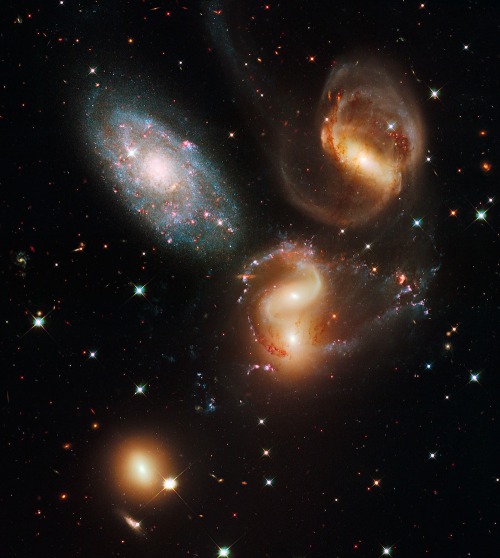
This portrait of Stephan’s Quintet, also known as the Hickson Compact Group 92, was taken by the new Wide Field Camera 3 (WFC3) aboard the NASA/ESA Hubble Space Telescope. Stephan’s Quintet, as the name implies, is a group of five galaxies. The name, however, is a bit of a misnomer. Studies have shown that group member NGC 7320, at upper left, is actually a foreground galaxy that is about seven times closer to Earth than the rest of the group.
Three of the galaxies have distorted shapes, elongated spiral arms, and long, gaseous tidal tails containing myriad star clusters, proof of their close encounters. These interactions have sparked a frenzy of star birth in the central pair of galaxies. This drama is being played out against a rich backdrop of faraway galaxies.
The image, taken in visible and near-infrared light, showcases WFC3’s broad wavelength range. The colours trace the ages of the stellar populations, showing that star birth occurred at different epochs, stretching over hundreds of millions of years. The camera’s infrared vision also peers through curtains of dust to see groupings of stars that cannot be seen in visible light.
Image: NASA, ESA and the Hubble SM4 ERO Team [high-resolution]
Caption: Hubble Heritage Team
VIA: Wired Science
Tuesday, November 20, 2012
Astronomers Believed to Have Found First Rogue planet
In case you're completely unfamiliar:
Rouge (nomadic/orphan/ETC) planets are, well, exactly what they sound like- planetary bodies which are not gravitationally bound to a parent star or system; instead revolving around galaxies themselves. These objects are believed to occur as a result of their having either been ejected from a parent system, or developing as a type of sub brown dwarf (objects that never quite attained enough mass to achieve fusion and become a star) that was never actually bound to any other object in the first place. Last week, a team of astrophysicists from the University of Montreal, reported the discovery of what they believe to be the first direct observation of such a planet.
The object in question; Planet "CFBDSIR2149" - which isn't even the entire designation for the object BTW- was found amongst a group of relatively young stars (around 50-120 million years old) which make up a formation called the AB Doradus Moving group. The apparent planet's "close" proximity to our own, around 75 light years from Earth, and the fact that there isn't a nearby parent star obstructing our view with it's own intense glow, means researchers have actually been able to do a detailed analysis of the object's atmosphere.
 |
| Actual image of newly found rogue planet CFBDSIR2149. Image Credit: CFHT/P. Delorme |
This isn't actually the first potential rogue planet ever to have been discovered. And there is always a chance that further observation could contradict these initial findings, given that this is the closest and least obstructed candidate yet known. But it seems likely at this stage that CFBDSIR2149, will end up as our first confirmed observation of an unbound planetary mass.
Oh, and in case you were wondering. Yes, people have already started asking the "Nibiru" question. Is Ancient Astronauts still a thing? And are they currently filming? If so, $20 says they're the first to work this angle into their...um, "theories".
-CAINE-
SOURCE: UdeMNouvelles, SLATE/BadAstronomy
Thursday, November 8, 2012
In Other Neil deGrasse Tyson News...

Neil shows up in Action Comics #14, to help superman find Krypton. Which, it turns out,
“is found 27.1 light-years from Earth, in the southern constellation Corvus (The Crow), orbiting the red dwarf star LHS 2520, which is cooler and smaller than our sun.”
Just in case you’re not sure, comic books aren’t real, so neither is planet Krypton. Though its a safe bet that it will be someday, in name anyway, should we ever actually find a planet orbiting LHS 2520, which is a real life star, located 2.7 years from Earth, ETC, Etc.
-CAINE-
VIA:Scientific American
Sunday, November 4, 2012
Nerdist: Star Talk Radio, With Neil deGrasse Tyson
Poste dy Youtube user: Nerdist
Yes, I know, this blog has pretty much just become a Nerdist commercial at this point. But it's awesome. Also, Neil deGrasse Tyson.
That is all.
-CAINE-
Sunday, September 16, 2012
"Ultra"-HD Render Of Curiosity's descent in 30FPS With (Fake) Sound
This version of Curiosity's descent and landing was created by film maker Bard Canning, using HD stills from Curiosity's Mars Descent Imager (MARDI), as well as hundreds of motion tracking shots; which basically just means digitally moving and zooming the camera to make up for missing frames, in order to increase the video's frame rate from a blistering 4 FPS to 30. The images in the film were enhanced and color corrected for the sake of quality, and the sound, obviously, was added for effect. Go HERE, For a more detailed explanation of the work that went into making this render of Curiosity's landing on Mars.
Monday, September 3, 2012
First interactive color Panorama from Curiosity
 |
| Click HERE for the full interactive Panorama. |
Via NASA.gov
This color panorama shows a 360-degree view of the landing site of NASA's Curiosity rover, including the highest part of Mount Sharp visible to the rover. That part of Mount Sharp is approximately 12 miles (20 kilometers) away from the rover.
The images were obtained by the rover's 34-millimeter Mast Camera. The mosaic, which stretches about 29,000 pixels across by 7,000 pixels high, includes 130 images taken on Aug. 8 and an additional 10 images taken on Aug. 18. These images were shot before the camera was fully characterized.
Scientists enhanced the color in one version to show the Martian scene as it would appear under the lighting conditions we have on Earth, which helps in analyzing the terrain. A raw version is also available.
Image Credit: NASA/JPL-Caltech/MSSS
Monday, August 6, 2012
First Images of Mars From Curiosity Rover


If you're on a webpage like this, chances are, you've already seen these pictures, and heard everything I could possibly say about the successful landing of Curiosity on Mars last night/early this morning, depending on your perspective and time zone. So, in closing;
Science is awesome.
That is all.
-CAINE-
Saturday, June 16, 2012
Dutch Company Mars One Plans One Way Manned Mission to Mars By 2023
Posted by YouTube user: MarsOneProject
The plan's pretty simple really, relatively speaking. In 2016, the company plans to place it's own communications satellite into orbit around Mars, followed by a rover in 2018, to scout locations for their proposed settlement. Living quarters and life support units, along with a second rover which will work in conjunction with the first to prepare said equipment, would arrive in 2020. And finally, in 2023, four Mars One astronauts would arrive to live out the rest of their lives on the martian surface. The settlement would then be kept alive by subsequent missions to the planet every two years, which would also bring new settlers with each trip.
Now, I'm a realist... Okay, I'm kind of a pessimist, if not a cynic, though I'm doing my best to try and be a little less of both those things. And while this is an obviously ambitious goal for any entity to try and accomplish, and one which I can't help but doubt will ever become a reality. The basic plan here, I think, is both a plausible and reasonable one. Particularly if you remember to take into account the exponential rate at which modern technology grows. And now that private industry has begun to get into the business of space exploration, just imagine the advances in space technology we can expect to see in the coming decade.
As for weather or not it's a worthwhile endeavor to even try and send people to live on another planet. I suppose that depends on what you think the ultimate purpose of space exploration really is. Because if it's just about cataloging facts about the universe. Then, as many have strongly argued, there's really no point in sending anything living out into the void, when robots are so much better suited for the task. On the other hand, if you happen to think the purpose of space exploration is, EXPLORATION. That human beings actually walking on the surface of other worlds and seeing those worlds with and our own eyes rather than over a live video stream, holds a value greater than simply collecting data. Then, like me, your answer is probably an enthusiastic, yes. And the idea that human beings living on another planet might actually be on it's way to becoming a reality, satisfies a fantasy you've been entertaining for a very long time.
And No, I don't mean the one with the girl with three boobs. I was actually trying to be all thoughtful and philosophical and stuff. Why do you always have to make everything dirty?
-CAINE-
Source: mars-one.com
Wednesday, May 23, 2012
Space X Launches Falcon 9 and Dragon Capsule
After a delayed launch on Saturday due to a faulty valve, Space X successfully launched it's Falcon 9 rocket carrying it's unmanned Dragon capsule into space early Tuesday morning. Once the rocket achieved orbit, the capsule itself was then able to successfully decouple and deploy it's own solar array.
On Friday, the capsule will undergo a series of maneuvers near the ISS to confirm it can be controlled well enough to dock with the station. When and if it does, it will then approach near enough for a crew member aboard the ISS to grab the capsule with the station's robotic arm, bringing it in to dock and deliver supplies. Assuming all goes as planned, the Dragon capsule will then return to earth, splashing down in the Pacific ocean off the coast of California, where it will then be retrieved.
If successful, Space X will become the first private company ever to deliver cargo to the ISS.
-Awesome.
-CAINE-
Subscribe to:
Posts (Atom)

