
Tuesday, November 20, 2012
Astronomers Believed to Have Found First Rogue planet
In case you're completely unfamiliar:
Rouge (nomadic/orphan/ETC) planets are, well, exactly what they sound like- planetary bodies which are not gravitationally bound to a parent star or system; instead revolving around galaxies themselves. These objects are believed to occur as a result of their having either been ejected from a parent system, or developing as a type of sub brown dwarf (objects that never quite attained enough mass to achieve fusion and become a star) that was never actually bound to any other object in the first place. Last week, a team of astrophysicists from the University of Montreal, reported the discovery of what they believe to be the first direct observation of such a planet.
The object in question; Planet "CFBDSIR2149" - which isn't even the entire designation for the object BTW- was found amongst a group of relatively young stars (around 50-120 million years old) which make up a formation called the AB Doradus Moving group. The apparent planet's "close" proximity to our own, around 75 light years from Earth, and the fact that there isn't a nearby parent star obstructing our view with it's own intense glow, means researchers have actually been able to do a detailed analysis of the object's atmosphere.
 |
| Actual image of newly found rogue planet CFBDSIR2149. Image Credit: CFHT/P. Delorme |
This isn't actually the first potential rogue planet ever to have been discovered. And there is always a chance that further observation could contradict these initial findings, given that this is the closest and least obstructed candidate yet known. But it seems likely at this stage that CFBDSIR2149, will end up as our first confirmed observation of an unbound planetary mass.
Oh, and in case you were wondering. Yes, people have already started asking the "Nibiru" question. Is Ancient Astronauts still a thing? And are they currently filming? If so, $20 says they're the first to work this angle into their...um, "theories".
-CAINE-
SOURCE: UdeMNouvelles, SLATE/BadAstronomy


Tuesday, January 31, 2012
Kepler Finds 3 Smallest Exoplanets

Just this December, NASA announced they had confirmed Kepler's detection of the two smallest exoplanets ever discovered, Kepler 20 e and Kepler 20 f, orbiting around the star Kepler 20, located 950 light years from Earth in the Lyra constellation. Both planets were estimated to be roughly the size of Earth, Kepler 20 f, being the largest of the two with an estimated diameter of around 13,200 km. Well, It's a mere month later now and it appears that three new planets have arisen to take the title of smallest known exoplanets for themselves.
Found orbiting the small red dwarf star KOI-961, which is located 130 light years from Earth, in the Cygnus constellation. KOI-961.01, KOI-961.02 and KOI-961.03 (I know, I wish they'd find a better way of naming these things too) are all believed to be rocky planets about the same size as Earth, the smallest of the three being about the size as Mars. So not only are the planets in this trio the smallest exoplanets yet discovered. But they now join the ranks of the very short list of confirmed exoplanets that are believed to be rocky worlds like our own, as well.
As for the BIG question that's always on every one's mind whenever any extra solar planet is discovered. According to NASA, the proximity to which these newly discovered worlds are believed to orbit their parent star, would it impossible for them to maintain surface liquids, and therefore -unlikely homes for life.
-CAINE-
Image Credit: NASA/JPL
VIA: jpl.nasa.gov
Wednesday, January 4, 2012
Planetquest: A Historic Timeline of the Search for Exoplanets
-CAINE-
You can checkout more videos from Planetquest HERE.
Sunday, September 18, 2011
Kepler Finds it's First Circumbinary Planet (Insert Obligatory Star Wars Refernce Here)
 Image Credit: NASA
NASA's Kepler mission has announced the first direct detection of a circumbinary planet – a planet orbiting two stars- in a binary star system designated Kepler-16, located 200 light-years from Earth. While potential planets have previously been detected in other binary systems, Kepler-16b, as this newest exoplanet is now known, is the first confirmed planet to have been observed orbiting both it's parent stars.
A binary star system, as the name suggests, is a system with two stars orbiting around a common center of mass. Because from our vantage point on Earth, each of the two stars regularly passes in front of the other during their orbit, Kepler-16 is classified as an eclipsing binary.
Observations of Kepler-16 showed a drop in light from the system, not only when the stars eclipsed one another, as expected, but also a when neither star was eclipsing the other, indicating the presence of a much smaller 3rd object orbiting around them. By measuring the gravitational tug applied to the stars by this third objects, scientists were able to estimate it's mass, and Kepler-16b, as the new planet is now known, is believed to be a cold, uninhabitable world, about the size of Saturn, comprised of gas and rock.
Though Kepler-16b may be a cold, gaseous world -incapable of harboring any Jedi resistance fighters -or even sand people. As Kepler's Principal investigator William Borucki points out, the confirmation of a planet orbiting in a binary system - which are much more common than the single star system in which we reside-
"confirms a new class of planetary systems that could harbor life," and "Given that most stars in our galaxy are part of a binary system, this means the opportunities for life are much broader than if planets form only around single stars. This milestone discovery confirms a theory that scientists have had for decades but could not prove until now."
 Sorry kids, not gonna happen. Besides, Star Wars happened in a different galaxy, duh.
-CAINE-
Source: NASA.gov
VIA: GGB on tumblr
Saturday, February 19, 2011
Still no Sign of Gliese 581g
 Image credit: Zina Deretsky
For those of you unfamiliar with the process of finding distant exoplanets, the problem, is that the VAST majority of these objects cannot be observed directly, and even those few extrasolar planets which have been seen, are little more than dots and blurs. In other words, it's not as if we can just point an optical telescope in the planets direction and have a quick look to confirm it's presence. Instead, these distant objects are identified by observing changes in their parent stars, such as shifts in the intensity of the light being emitted by the star or "wobbles" in it's position. From this data, which is typically accumulated over a period of years to build a worthwhile data set, researchers are then able to estimate the size of the planet and the distance at which it orbits it's parent star.
Though the initial re-analysis conducted by the Swedish team did included an additional 2 years worth of observations made by the HARPS Spectrograph in Chile, it did not include data collected by the HIRISE spectrograph in Hawaii. And because the American team used a combination of these two data sets in their research, it's entirely possible that the planet's existence can only be confirmed using both sets. Which is why in January of this year, astro-statistics expert Phillip Gregory of the University of British Columbia, published the first re-analysis of the combined data sets. The results, he too has been unable to confirm the initial observation and has concluded that they were most likely based on statistical error.
While Gregory's findings certainly don't help the case for 581g, that doesn't mean the planet is officially down and out, as subsequent analysis of the data could easily tilt the scales the other direction. As for a final word on the existence of the planet, even if the next study confirms the initial findings, it will likely be years before the planet is either officially accepted or rejected by the scientific community. Hey, no one ever said science was fast.
-CAINE-
Source: wired science
Image credit:Zina Deretsky
Saturday, October 23, 2010
An Exoplanet With a Mysterious Hot Spot
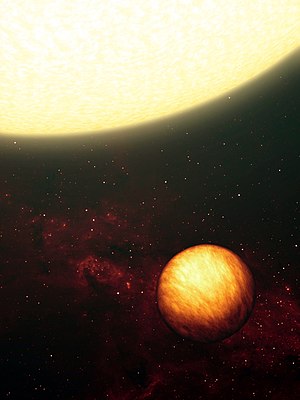
First discovered in June of 1996 by Geoffrey Marcy and R. Paul Butler, The Exoplanet Upsilon Andromedae b orbits the solar twin star Upsilon Andromedae, located 44 light years from Earth in the Andromedae constellation. Because of it's estimated mass and proximity to it's parent star, which it's believed to orbit in just 4.6 days, UAb is categorized as a type of gas giant known as a "Hot Jupiter" planet. Recent observations of the system, made by the Spitzer Space Telescope, have shown that the planet may have an unexpected hot spot.
The planet itself cannot be observed directly from Earth but the Spitzer Space Telescope is able to measure the total amount of infrared light being emitted by the system in which it resides, which Logically one would expect to rise as the planet made it's way behind it's sun. Instead, Spitzer observed the system to be at it's brightest when the planet was to the side of it's parent star, indicating that it's hottest point was offset by as much as 80 degrees.
While there are several theories as to the cause of this perceived anomaly, including supersonic winds and magnet interactions between planet and star, they are just speculation as even the existence of Upsilon Andromedae b, like most other exoplanets, is based entirely on wobbles in the orbit and dips and rises in the wavelength of light coming from it's parent star.
-CAINE-
Source:NASA JPL
Friday, October 15, 2010
Update on Gliese 581g

You may recall that earlier this month a team of US researchers led by astronomer Steven Vogt of the University of California, Santa Cruz, announced that they had discovered a fifth planet in a system orbiting a Red Dwarf (Gliese581) located around 20 light years from earth. More importantly, the planet (officially designated Gliese 581g) was believed to be orbiting it's parent star in it's so called habitable or "Goldilocks" zone, and was therefore deemed capable of sustaining life and dubbed the "most Earth-like" exoplanet ever discovered.
Lead astronomer Steven Vogt took his own his own speculations about the planet even further, publicly stating his belief that the chances of life on the newly discovered planet was 100 percent and in a subsequent interview with i09, renaming the new planet "Zarmina" after his wife, before moving on to described what life and even a human colony might be like on the surface of the tidally locked planet.
Well, as you may already be aware. A group of Swiss researches attempting to confirm the findings of the US research team, announced earlier this week that they had been unable to find any reliable sign of a fifth planet located in Gliese's habitable zone.
Oops.
While this announcement doesn't necessarily mean the existence of the planet won't eventually be confirmed, a complete analysis of the data used to make the discovery-which was collected over a period of eleven years- will take some time, possibly several years, to complete.
-CAINE-
Source:Science/AAAS via:80 Beats
Friday, October 1, 2010
Eye Candy: Speaking of Exoplanets- Sunrise on Gliese 876d
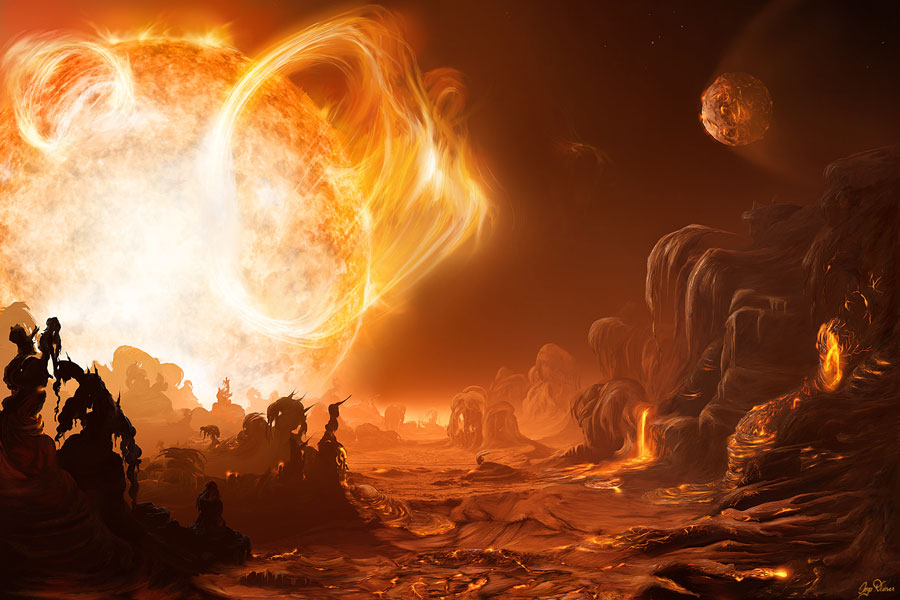
In keeping with not only our exopoplanet theme but red dwarfs named "Gliese", the above is an artists depiction of a sunrise on a planet known as Gliese 876d, the third planet discovered orbiting the red dwarf Gliese 876- located fifteen light years away in the constellation of Aquarius. The rest of the text in this article as well as the image, comes directly from NASA's " Astronomy Picture of the Day" website.
-CAINE-
Illustration Credit & Copyright: Inga Nielsen (Hamburg Obs., Gate to Nowhere)
Explanation: On planet Gliese 876d, sunrises might be dangerous. Although nobody really knows what conditions are like on this close-in planet orbiting variable red dwarf star Gliese 876, the above artistic illustration gives one impression. With an orbit well inside Mercury and a mass several times that of Earth, Gliese 876d might rotate so slowly that dramatic differences exist between night and day. Gliese 876d is imagined above showing significant volcanism, possibly caused by gravitational tides flexing and internally heating the planet, and possibly more volatile during the day. The rising red dwarf star shows expected stellar magnetic activity which includes dramatic and violent prominences. In the sky above, a hypothetical moon has its thin atmosphere blown away by the red dwarf's stellar wind. Gliese 876d excites the imagination partly because it is one of the few extrasolar planets known to be close to the habitable zone of its parent star.
Gliese 581G The New Earth We'll All Soon be Living On - or Not.
 Artists depiction of Gliese 581G
The new planets were both discovered using the Doppler method which measures the shift in the wavelength of light being emitted by a star which, changes when tugged on by the gravity of an object orbiting around it. A planet's mass, the shape of its orbit, and it's distance from it's sun, all effect how the light shifts allowing astronomers to devise specific details about distant objects like these two new Exoplanets of which, the most talked about has been designated Gliese 581G.
With a mass of three to seven times that of the Earth, Gliese 581G is the sixth to be identified orbiting Gliese 581 and is the newest planet in the system to be marked as a potential home for life. Unlike Gliese 581C - which is likely too close to it's star and therefore too hot to sustain liquid water or life - and Gleise581D - which is likely to0 far away from the sun and therefore too cold (or maybe not if it has a thick enough atmosphere) - Gliese 581G orbits it's sun in the so called "Goldilocks Zone" making it the most likely contender yet for a planet capable of sustaining life.
Like the rest of the known planets in the system, 581G follows a circular orbit around it's sun, it completes an orbit every 37 days and is, as far as we can tell, the fourth planet from it's sun. Gliese is also tidally locked to it's star. That means one side of the planet is always facing the sun locking it in a state of perpetual daylight , while the other faces away leaving it in total darkness- which would make the line between shadow and light or terminator, the most habitable place on the planets surface. Researchers also estimate the average temperature on the planet to be between -24 and 10 degrees Fahrenheit.
But contrary to the popular take on this story, which professor of astronomy and astrophysics at the University of California, Santa Cruz, Steven Vogt is not helping by saying things like:
Don't go packing your bags or planning what deep space message you'll be sending to the people of Gliese just yet. While this is an amazing discovery, aside from details about it's mass, orbit, and general surface temperature, not much else can be said for certain about what the planet is actually like. The more important point of this planets discovery is what it could mean for the odds of finding other "Earth-Like" planets capable of sustaining life. Because the fact that a planet like this has been discovered in a system not only within our own galaxy but within 20 light years of our own solar system, is a good indication that habitable planets are in fact abundant throughout our galaxy.
-CAINE-
You can read the original press release from The University of California: HERE. You should also check out Phil Plaits post on this subject as well which is the most detailed post I was able to find on the subject.
Monday, October 11th, 2010 - Astronomer Francesco Pepe of the Geneva Observatory and the Swiss group announced that they had been unable to find any reliable sign of a fifth planet in Gleise's habitable zone.
Oops.
Go HERE for more info.
Wednesday, August 4, 2010
Kepler potentially Discovers 140 Earth-like planets

During a recent presentation at the TEDGlobal Conference in Oxford New york, Kepler co-investigator Dimitar Sasselov released data from the probe identifying 140 new objects as potential Earth-like planets located throughout the Milky Way. According to Sasselov, of those objects thus far detected by Keppler small Earth-sized planets "dominate the picture" and he estimates the number of worlds in the Milky-way alone with the potential to harbor some form of life at 100-million. Though not yet officially confirmed by NASA, if Sasselov's interpretation of the data holds true, then further analysis of these exoplanets could lead to the first confirmation of life on another world.
-CAINE-
Also check out Ian O'Neil's article on this story from Discovery News which was my primary source and go search TED for more talks.
Image credit:David A Hardy
Friday, July 16, 2010
Exoplanets: Osiris's Tail

As far back as 1855 Observations were made of distant stars which suggested that they might in fact have planets orbiting around them. But the first Published discovery of a planet orbiting a star outside of our own solar system to later receive confirmation was not made until 1988 when Canadian astronomers Bruce Campbell, G. A. H. Walker, and S. Yang made radial-velocity observations which suggested that there was a planet orbiting the star Gamma Cephei. The trio's observations would eventually be confirmed in 2002.
Today projects like Trappist, a new robotic telescope from the ESO designed to detect exoplanets, and Keppler a NASA space observatory launched in March of 2009, have helped us to detect over 450 planets orbiting distant stars. One such planet is Osiris or HD 209458b which orbits the star HD 209458 in the Pegasus constellation 150 light years away from earth.
Osiris was first spotted in 1999 and additional observation of the planet have since confirmed that the gas giant has not only water vapor in it's atmosphere but methane as well as carbon dioxide and that the Planet's orbit is a mere one eighth the radius of Mercury's. Meaning, Osiris revolves around it's own sun in just 3.5 days leaving it with an estimated surface temperature of 1000 degrees Celsius. Now new observations of Osiris made by the Hubble Space Telescope's Cosmic Origins Spectrograph have confirmed that the consequent evaporation of the planet's atmosphere mean the gas giant leaves behind itself a tail like a comet as it's atmosphere is slowly burned away.
-CAINE-
You can find out more about Osiris by visiting this article on the discovery blog: 80beats, which was my main source for this story. Or if you just want more info on exoplanets in general check out NASA's PlanetQuest site which is full of pictures, multimedia presentations and other cool stuff. But my personal favorite link of the day, the Exoplanetology blog right here blogspot which I stumbled upon while googling for this entry and ended up being distracted by for quite some time.
Image Credit:John Whatmough

