
Showing posts with label stars. Show all posts
Showing posts with label stars. Show all posts
Tuesday, January 29, 2013
APOTD: Molecular Cloud in Monoceros
 |
| Image: T.A. Rector (University of Alaska Anchorage) and N.S. van der Bliek (NOAO/AURA/NSF) [high-resolution] Read NOAO Conditions of Use before downloading |
Caption: NOAO
This image was obtained with the wide-field view of the Mosaic II camera on the Blanco 4-meter telescope at Cerro Tololo Interamerican Observatory on January 11th, 2012. It shows a portion of the giant Monceros R2 molecular cloud. It is a location of massive star formation, particularly in the location of the bright red nebula just below the center of the image. The image was generated with observations in the Sulphur [SII] (blue) and Hydrogen-Alpha (red) filters. In this image, north is to the right, and east is up.


Monday, December 24, 2012
This Week's Time Lapse: While You Were Sleeping, Perseid Meteor Shower 2010-2012
Posted by YouTube user: JeffSullivanPhoto
Via YouTube description:
"Three years in the making and mastered in 4K video resolution four times
greater than1080p HD, this astrophotography footage by Jeff Sullivan
was waiting for the perfect musical accompaniment, which turned out to
be "While The Sun Was Sleeping" by Life Audience."
Sunday, December 16, 2012
APOTD: 5 Galaxy Pile Up
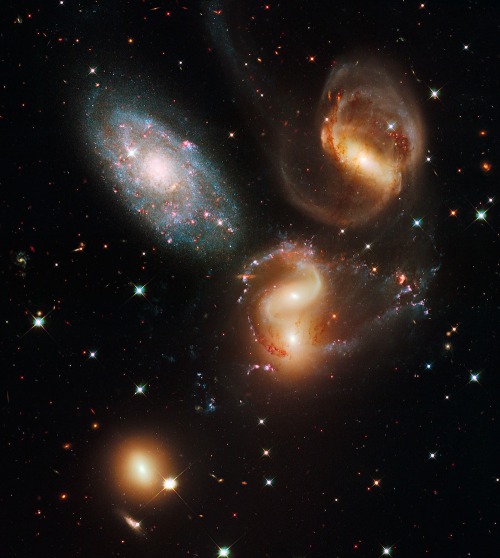
This portrait of Stephan’s Quintet, also known as the Hickson Compact Group 92, was taken by the new Wide Field Camera 3 (WFC3) aboard the NASA/ESA Hubble Space Telescope. Stephan’s Quintet, as the name implies, is a group of five galaxies. The name, however, is a bit of a misnomer. Studies have shown that group member NGC 7320, at upper left, is actually a foreground galaxy that is about seven times closer to Earth than the rest of the group.
Three of the galaxies have distorted shapes, elongated spiral arms, and long, gaseous tidal tails containing myriad star clusters, proof of their close encounters. These interactions have sparked a frenzy of star birth in the central pair of galaxies. This drama is being played out against a rich backdrop of faraway galaxies.
The image, taken in visible and near-infrared light, showcases WFC3’s broad wavelength range. The colours trace the ages of the stellar populations, showing that star birth occurred at different epochs, stretching over hundreds of millions of years. The camera’s infrared vision also peers through curtains of dust to see groupings of stars that cannot be seen in visible light.
Image: NASA, ESA and the Hubble SM4 ERO Team [high-resolution]
Caption: Hubble Heritage Team
VIA: Wired Science
Sunday, June 3, 2012
This Week's Time-Lapse: Temporal Distortion
Been one of those week's when I just haven't been able to make time for much of anything I actually want to do. Gonna try and get some stuff up today. For now, here's another vid from Dakotalapse, on vimeo.
Enjoy-
-CAINE-
Enjoy-
-CAINE-
Subscribe to:
Posts (Atom)

